
Find out how to spot a genuine handcrafted block print. This guide reveals the key characteristics of a genuine hand-printed Indian cotton fabric. 🎨
Features :
A genuine handcrafted block print can be recognised by its unique and slightly irregular patterns. Unlike industrial printing, each stamp impression leaves a distinct mark, revealing the artisan’s handcrafted work. The colours exhibit natural variations and are never perfectly uniform. Indian craftsmanship, passed down from generation to generation, guarantees unrivalled quality.
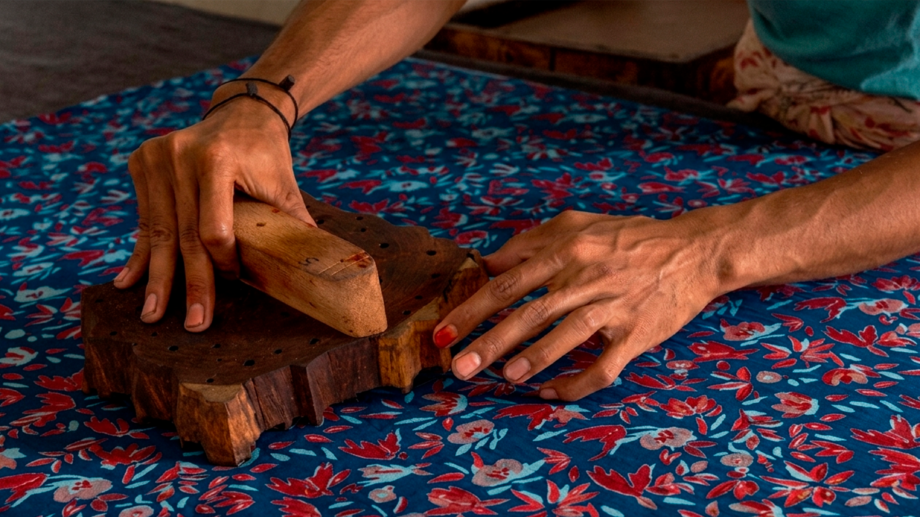
Authenticity can be verified by examining the wooden block used. Traditional blocks, carved in Rajasthan, bear the marks of time. If you look at the reverse side of the fabric, you will see characteristic traces of ink that are impossible to reproduce industrially. The artisanal technique creates layers of colour where the pigments overlap slightly. To better understand this visual richness, you can also find out what Indian block printing is.
Patterns, colours and natural dyes
Natural dyes are at the heart of authentic Indian block prints. Indigo, a deep blue pigment native to India, dominates traditional designs. The natural pigments used by Indian artisans produce colours that evolve over time. Lovers of authentic materials particularly appreciate these hand-printed patterns on cotton, precisely because they retain a visual quality that cannot be standardised.
Differences between traditional block printing and industrial printing
Industrial printing produces a perfectly uniform result, whereas the handcrafted block print displays deliberate variations. Textiles produced in batches exhibit a consistency that is somewhat suspicious, lacking the micro-irregularities characteristic of handmade work. The cotton used in traditional crafts has a more authentic texture. By comparing two items, you will notice that the genuine block print offers a visual depth that is absent from the copies.
A genuine hand-printed textile does not strive for mechanical perfection; on the contrary, it embraces the small imperfections that give it its value.
The history of block printing: a time-honoured craft
Indian block printing dates back several centuries and has its roots in the traditions of Rajasthan. Artisans in Rajasthan, particularly in Jaipur, carry on a craft that has been passed down through the generations. This printing technique continues to influence contemporary fashion and interior design worldwide. Even today, it inspires creations such as the handcrafted kimono or certain hand-printed cotton garments.
Manufacturing stages
The process begins with carving the block of wood, usually made of teak. The craftsman carves every detail of the design with precision. The block is soaked in natural dye, then applied to the cotton fabric with a skilful stroke. The complex patterns require several blocks and multiple passes, with each colour being added gradually.
This slow process explains why each piece has its own unique character. This meticulous craftsmanship is evident in certain pieces, such as the lightweight block-printed cotton dressing gown, where the hand-printed design becomes a key stylistic feature.
The origins and values of ethical craftsmanship
Le block print provient du Rajasthan, région historiquement riche en artisanat textile. Les artisans locaux maintiennent des pratiques éthiques, respectueuses de l’environnement. L’utilisation de teintures naturelles minimise l’impact environnemental comparé aux textiles industriels. Choisir un véritable block print soutient une tradition vivante et des pratiques durables.
Care instructions for block-printed textiles
To preserve your block-printed fabric, it is essential to set the colours after the first wash. Use cold water and a mild soap. Soaking in white vinegar helps to set the colours permanently. Dry in the shade to protect the intensity of the dyes. For further information, you can read our article on how to care for hand-printed cotton.
Conclusion
Recognising an authentic block print requires an eye for detail: irregularities in the patterns, variations in colour, and traces of the carved wooden block. By choosing genuinely handcrafted fabrics, you are investing in sustainability and ethical practices. Every purchase supports Indian artisans and preserves a tradition dating back thousands of years. The Bohosoleil collection offers authentic clothing and accessories, selected for their artisanal quality. Each piece tells a story of Indian craftsmanship, whether it is a printed cotton fabric, a handcrafted kimono or an item featuring Indian block printing.